
AI-Ready Enterprise Technology: An Executive Brief for CIOs & CDAOs
A playbook to select the optimal Data and AI platform architecture for the Enterprise

As a leader keen on modernizing your enterprise data platform for the agentic AI era, you and your team should primarily focus on improving data and AI governance, leading to a more coherent overall architecture.
The goal of this modernized platform should be to facilitate rapid development while upholding essential non-negotiables like security, privacy, and cost-effectiveness. Crucially, this should be achieved without creating infrastructure lock-in.
To support AI innovation, you need an architecture that maintains a standardized, well-governed core data + AI platform, allowing for innovation at the edges.
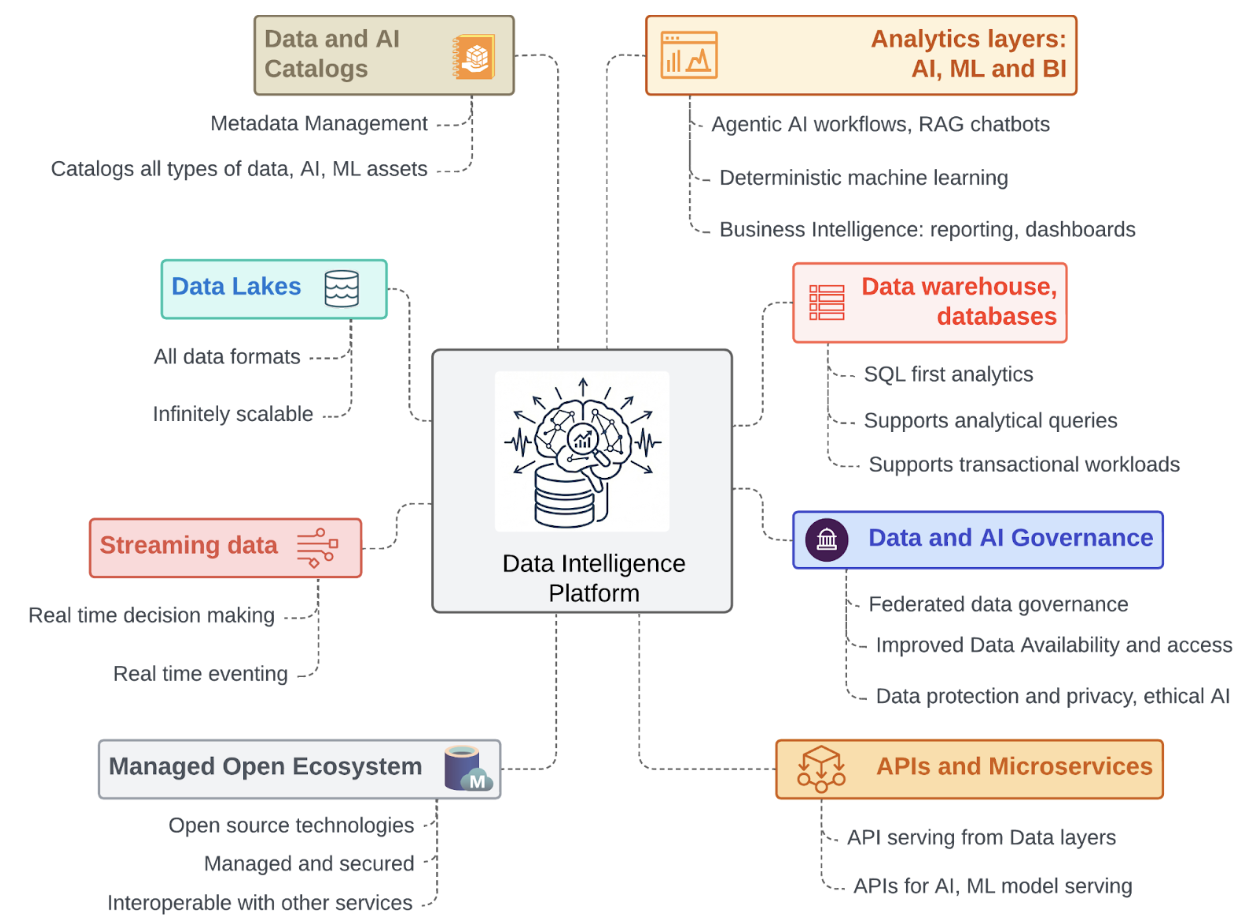
Data and AI Platform Architecture
Standardize your core to deliver value fast; innovate at the edges
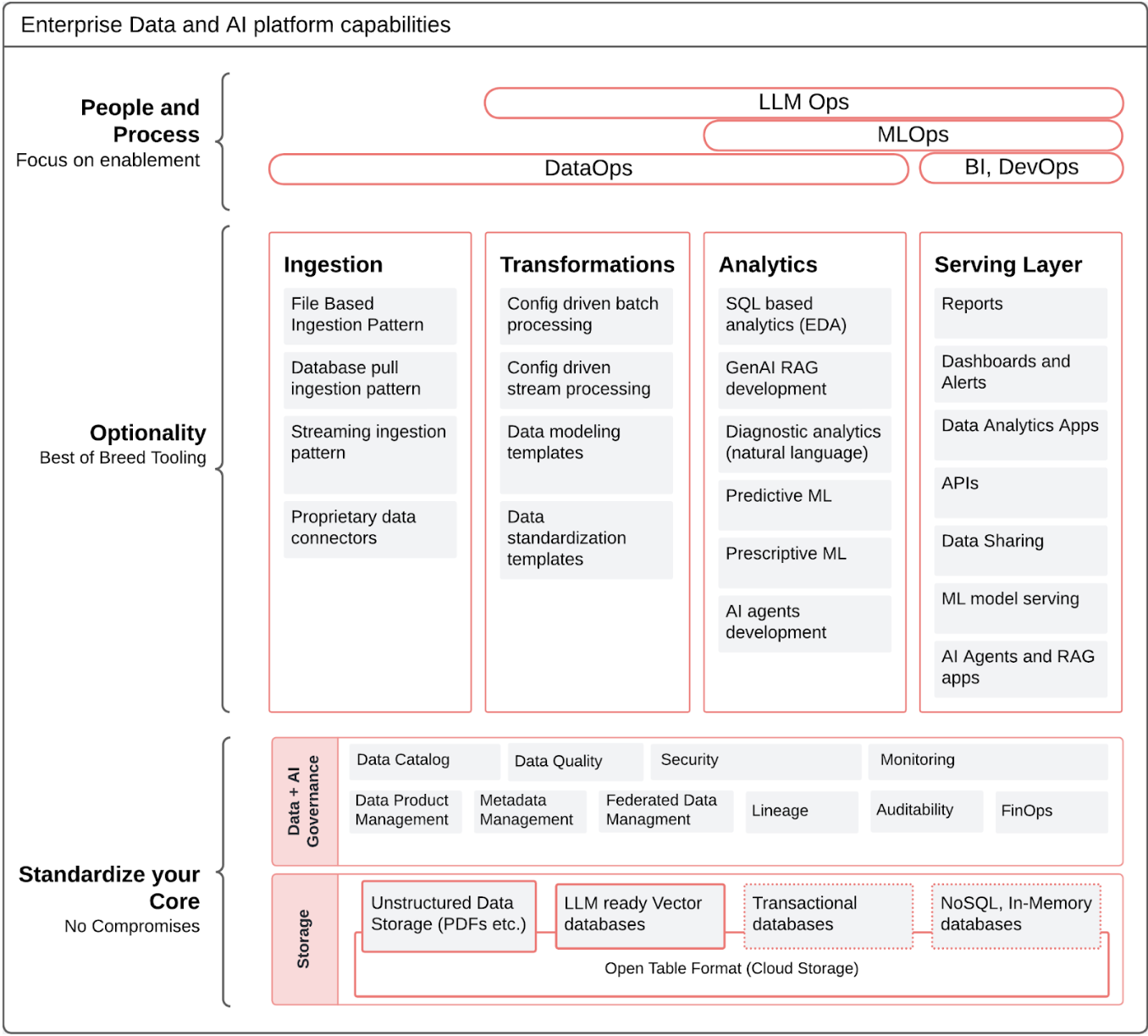
A comprehensive Enterprise Data and AI platform must offer a complete range of capabilities, grouped into key categories, to address most business use cases. Successful adoption and value delivery also require the organization to implement DevOps processes to automate and reduce friction. In a mature platform, each tenant of the platform focuses solely on delivering business value and enjoys the benefits of a well secured, governed, scalable and cost efficient platform.
Databricks as the standardized core data + AI platform
When Databricks’ capabilities are mapped to the requirements of an Enterprise data platform, it becomes very clear that very few market alternatives offer the same combination of comprehensive capabilities.
Databricks accelerates value delivery through ease-of-adoption, robust scalability, and cost efficiency. Furthermore, Databricks helps you avoid critical vendor lock-in by utilizing open standards across several core architectural components.
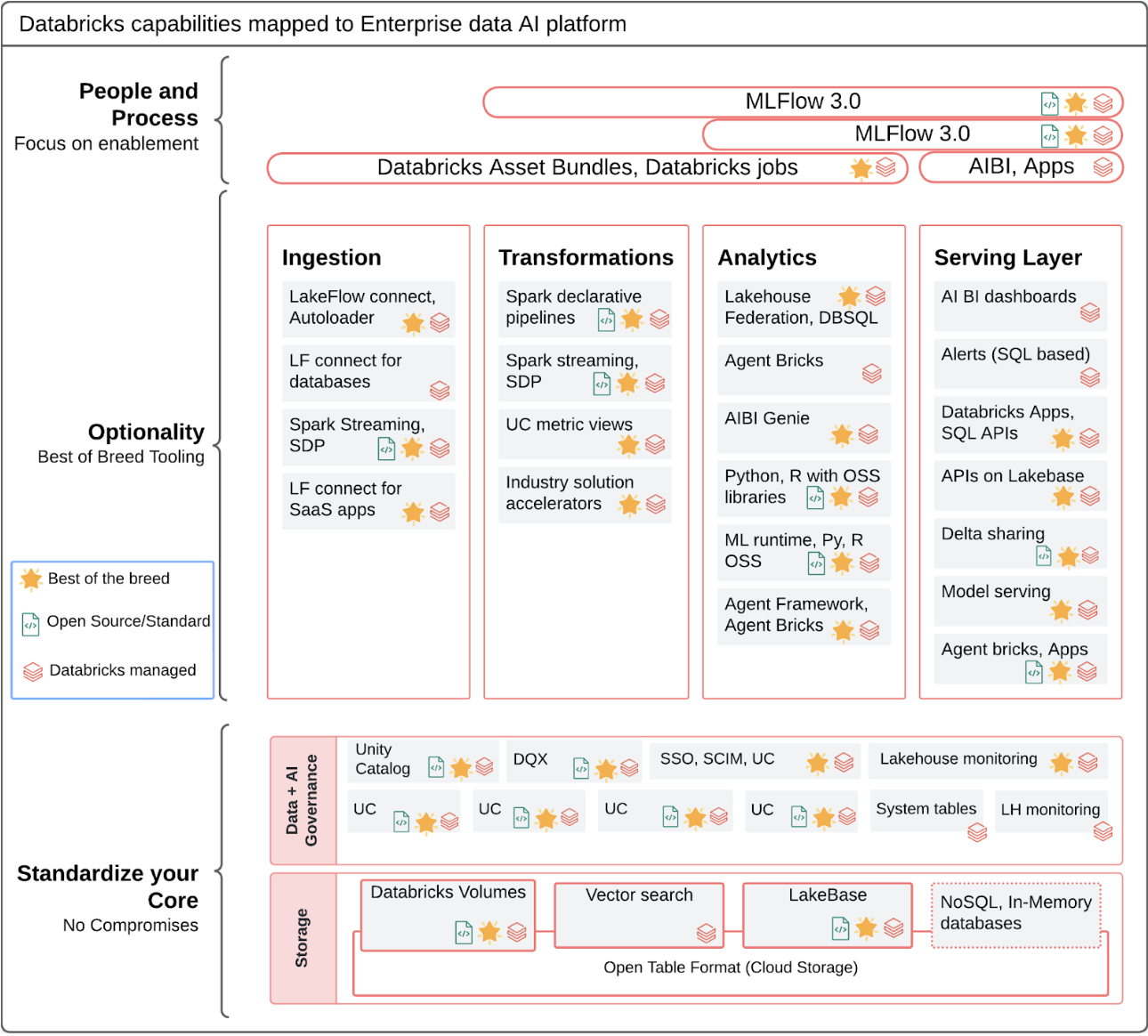
Today, modern enterprises face a major challenge: Architectural Fragmentation. In contrast to the hyperscalers (AWS, Azure, GCP) which provide fragmented point services requiring manual integration, Databricks offers a Unified Core. This unified approach accelerates value delivery and promotes standardization for the most critical element: your core data and AI platform.
The Databricks open architecture further enables innovation. Its compatibility with open-source community and partner solutions allows you to innovate at the edges of your architecture without the need for expensive data migrations or data movements, all of this while maintaining consistent data and AI governance.
Conclusion
To achieve the modernized data and AI strategy, executives should:
Standardize the Core: Use Databricks for ingestion, governance, processing, and AI development to ensure a unified data estate.
Flexible Edges: Use cloud-native services (like Azure Entra for Identity, experiment with Azure AI foundry or use AWS S3 for storage) only where they provide commodity infrastructure value.
Verdict: Standardizing on the Databricks Data Intelligence Platform eliminates the integration tax paid to the cloud providers and ensures the enterprise is architecturally prepared for the agentic AI era.
Appendix
Strategic Business Metrics to measure
A. Total Cost of Ownership (TCO)
Databricks utilizes the Photon Engine and Serverless Compute, which are optimized for high-performance data workloads. By processing data faster, the system reduces the duration of compute cycles, often resulting in a 20-40% reduction in total infrastructure spend compared to legacy cloud-native architectures.
B. Vendor Lock-in & Open Standards
A critical C-level concern is the "Proprietary Vault" problem.
Databricks: Built on Open Standards (Delta Lake, Iceberg, MLflow). This provides an Insurance Policy; your data remains in your storage buckets in an open format. If you choose to leave the platform, your data is still readable.
Market Competitors: Often utilize proprietary formats or metadata layers that make migration prohibitively expensive.
C. Market Adoption & Talent
By standardizing on Apache Spark and MLflow, Databricks aligns with the industry's largest talent pool. Hiring engineers for a standardized, open-source-based stack is significantly easier and more cost-effective than finding specialists for proprietary cloud-native tools.
